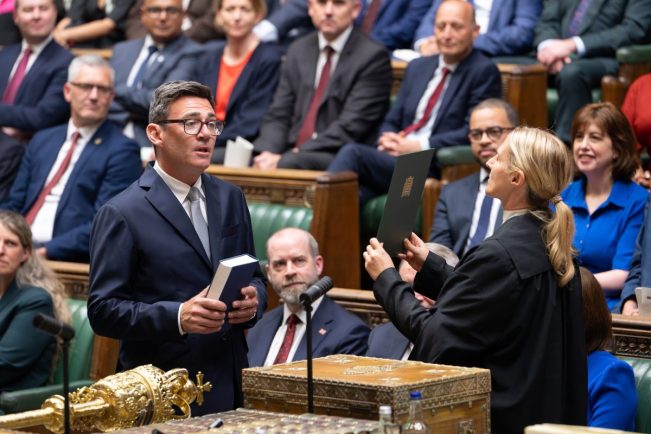
Fund tells incoming prime minister to prioritise deficit reduction over tax increases.
The International Monetary Fund has issued a warning to Andy Burnham, urging Britain’s incoming prime minister to resist pressure for increased public spending and instead concentrate on narrowing the government’s deficit.
In its latest assessment of the UK economy, the Washington based institution said ministers should be highly selective about approving new spending commitments, pointing to mounting debt, rising interest costs, and the growing financial burden of healthcare and pensions as the population ages.
The intervention comes just as Mr Burnham prepares to deliver a speech on Friday, at the conference where he will formally become Labour leader, in which he is expected to commit to a distinctly Labour approach that could involve higher taxation and spending. He is expected to argue that the country needs to break from an economic direction it has followed for roughly four decades.
Nationalisation speculation
Reports have also suggested Mr Burnham could move quickly to bring Thames Water under public ownership shortly after taking office, amid growing speculation about the future of the struggling utility company. According to Bloomberg, his team has instructed civil servants to prepare policy options covering both energy and water. Estimates suggest nationalising Thames Water alone could cost around £20 billion.
Fund recommends reallocation, not expansion
While acknowledging the need for greater investment in defence and climate related policy, the IMF advised against further tax rises, warning these could harm economic growth. Its report followed Mr Burnham’s own admission, made a day earlier, that he was open to asking the public to contribute “a little more” through taxation.
The Fund said any future spending reviews should prioritise shifting resources between government departments rather than increasing overall expenditure, and recommended reforms such as replacing the pension triple lock with a system tied to the cost of living, alongside wider charges for some NHS services, while ensuring protections remain in place for the most vulnerable.
Political reaction
Shadow chancellor Sir Mel Stride said the IMF’s assessment was correct, arguing that further tax increases would cause additional economic harm and that spending, particularly on welfare, needed to be brought under control.
Reform UK’s economic spokesman, Robert Jenrick, said cutting unnecessary spending was essential to restart economic growth, accusing Mr Burnham of pursuing more taxation and spending instead.
Conservative leader Kemi Badenoch called for the swift approval of new North Sea oil and gas drilling, describing it as a straightforward step Mr Burnham should take rather than pursuing wealth taxes or property levies.
Chancellor Rachel Reeves defended the government’s record, stating that the current economic strategy had strengthened Britain’s position over the past two years and noting the IMF’s broad support for the choices she has made.
Wider warnings on tax burden
The IMF’s comments echo similar concerns raised a day earlier by the Organisation for Economic Co-operation and Development, which said Britain’s record tax burden meant the incoming prime minister would need to focus on reducing spending rather than raising revenue further.
The Fund also noted that Britain’s tax to GDP ratio is on track to reach historic highs, and warned that relying solely on tax measures to fund new spending pressures could distort the economy and weaken growth. It highlighted that VAT and property taxes are already comparatively high, while further increases to capital gains tax could risk driving wealthy individuals abroad. Income tax increases, it added, could also reduce revenue by discouraging people from working.
Separately, Mr Burnham is reportedly considering approving new North Sea oil and gas projects, including potential support for drilling at the Jackdaw and Rosebank fields, alongside possible changes to rules governing new wells near existing infrastructure.