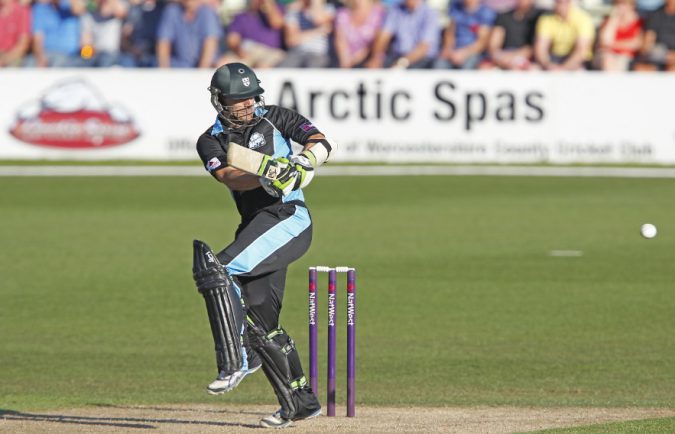
DAVID Leatherdale brought down the curtain on 31 years as a player and then administrator with Worcestershire CCC, latterly as chief executive.
Leatherdale will now take up the role of CEO with the Professional Cricketers’ Association and shared his reflections on three decades at New Road.
It’s the end of an era for you David?
It’s 30 full years really. I played my first second eleven game in 1985 at Ombersley. I remember it well. It seems a long time ago.
I had 20 years of playing and the days of Botham, Dilley and the winning Championship sides of 1988 and 1989 and the other one-day wins we had. Thirty years is a long time both on and the pitch.
How did the Worcestershire link come?
I had just played in the Oxford-Cambridge Schools Festival at 17 for Yorkshire and they at the time offered me a registration document which basically meant you couldn’t go anywhere else without their say-so.
Myself and my dad went back and asked the question whether I would be guaranteed some second team cricket or just a couple of games the following season to show what I could do. At the time they said ‘no.’
Because Richard Illingworth and Steve Rhodes had come down from Yorkshire, it was Richard’s dad, Keith, who said ‘why don’t you write to Worcestershire for a trial’ which I did.
I got offered a game at the end of my first year of doing ‘A’ levels in 1985 in September at Ombersley and then I did my ‘A’ levels and came down for three months in 1986 and got offered a contract in August of that year for the following season.
A good time to join with the success the club was about to have?
When it was announced, there was a piece in the newspapers saying ‘Worcestershire sign three new players – Botham, Dilley – and Leatherdale! It is probably the first and last time all three have been mentioned in the same way.
I made my debut in 1988 and I think in the next three to four years, we won seven trophies. I played at Lord’s in the 1988 Natwest final against Middlesex. Mark Ramprakash was another young lad at the time who I had played schools cricket with.
We were 10-3 when I went to bat in front of 20,000 plus people and I got 29 which felt like about 300!
We got to about 160 and then we had them 25-5 and Dill (Diley) bowled like God. He swung it and bowled at pace and had Ramps lbw first ball.
It would have been 25-6 but Dickie Bird didn’t give it and Dill went ballistic. He got 50 odd and Paul Downton 30 odd and they won by two wickets.
It was a pretty social sort of environment, everyone enjoyed each other’s company, but we had some high class players and nine or ten of them were present of recent England internationals.
Do you have one particular highlight of your playing career?
There are a couple. The obvious one is when we played the Australians in a one-day game at New Road when I got 5-10 and we had bowled them out for 140.
Steve Waugh had written in his Ashes diary book that Australia were bowled out by a side with one bowler who wouldn’t get a bowl in a Chinese restaurant and that obviously referred to me.
It did come back to haunt him a few years later when he played for Kent and I got him out for one in a one-day game and all the lads, particularly Mr Pipe our wicket-keeper who was fairly vociferous, ran past him and said ‘I’ll have a number 57 with fried rice’.
I gather that he was quite petrified after what he had written in his book when he came out to bat.
You graduated from Commercial Director to Chief Executive, that must have been a big leap?
When the club came and said they’d like to appoint me, it was a tough time. It was 2010. We’d lost players, we’d had major cutbacks, we’d cut back over half a million pounds in one year when we had the floods.
We had to make some pretty tough decisions. When Mark Newton left, I became chief executive, commercial director, HR manager, PR manager, all rolled into one because we had to make those changes.
But we’ve gradually changed those things, the club has progressed to what we can see today, and will only do so further.
There have been a lot of developments at New Road?
Building the Graeme Hick Pavilion was the proverbial no-brainer. It used to cost us a fortune just to keep the old pavilion going. The players facilities were shocking and I can vouch for that having had the space in the dressing room under the stairs next to the toilet!
The sort of mission when I took over was that it needed to be a 365 days a year sustainable business. Other counties have recognised over the last two or three years, that is what they need to be doing.
We are still in the bottom four of the 18 for playing budget but four or five years on we are bringing through and producing cricketers that can play for England.
Will you be sad to leave?
Very much so. Telling the chairman on Christmas Eve when having a coffee in his kitchen was not the most pleasant experience.
Would I want to go and work for another county or come back and play against the county I’ve been at for 30 years? I think I might find that difficult, particularly in the short term, to leave one county and go straight to somewhere else.
There are a lot of people who have been involved in this club a long, long time.
But the game is changing. There is no doubt that the game is not going to be in the same place in five years time as it is now.
Visit www.wccc.co.uk for more from David Leatherdale’s departing interview.