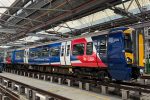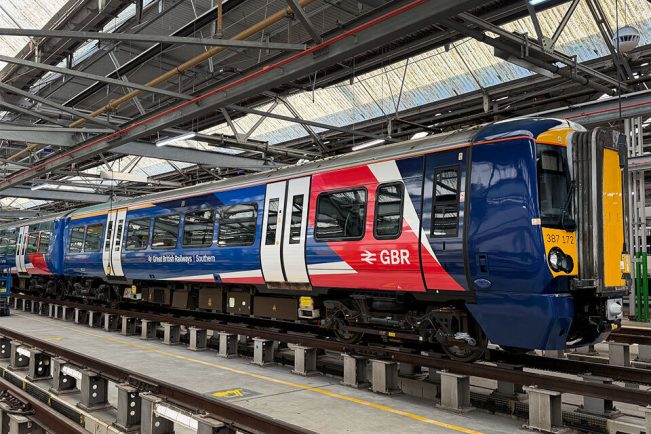
Britain’s railways will take another symbolic step towards public ownership today as the first train carrying the new Great British Railways (GBR) branding will be unveiled in Brighton, marking a major milestone in the Government’s plan to bring the country’s passenger rail services back under state control.
The Class 387 train, operated by Southern, debuted in a striking red, white and blue livery that ministers say will gradually become a familiar sight across England’s rail network over the coming years.
The launch comes ahead of Govia Thameslink Railway’s formal transfer into public ownership on 31 May, with Thameslink, Southern, Great Northern and Gatwick Express all set to join the government-run system.
The move represents one of the clearest signs yet that Great British Railways, once a political proposal, is rapidly becoming reality.
Transport Secretary Heidi Alexander hailed the unveiling as “an important step towards building a more joined-up, publicly owned railway that puts passengers first”. She added that the reforms would help leave behind “the frustrations and fragmentation of the past”.
Labour says bringing train operators into public ownership will simplify ticketing, improve accountability and create a more coherent national rail network after decades of fragmentation following privatisation in the 1990s under the Conservative government of John Major.
Ministers have also pointed to performance figures at some already publicly run operators, including c2c and Greater Anglia, as evidence the model can deliver more reliable services. Passengers are also being promised a more integrated experience under GBR, including a national rail app combining ticket purchases, journey planning and passenger assistance in one place.
Supporters of renationalisation argue Britain’s privatised railway system has too often failed passengers with confusing fares, poor reliability and rising costs, while private operators extracted profits from taxpayer-supported services. Public ownership, they argue, offers the chance to focus on long-term investment and passenger outcomes rather than shareholder returns.
Yet critics remain unconvinced that state ownership alone will solve the railway’s deeper structural problems.
Conservative politicians and free-market campaigners have long argued that nationalisation risks driving down standards by weakening competition and increasing bureaucracy. Former Conservative minister Sir John Redwood recently pointed to the troubled HS2 project as evidence that state-led rail projects can spiral out of control. He described HS2 as “a warning to all those who think a nationalised railway will be so much better”, arguing that despite vast taxpayer funding, the project has suffered from mounting costs, delays and scaled-back ambitions.
Originally proposed as a high-speed line linking London with Birmingham, Manchester and Leeds, HS2 has since been partially cancelled and repeatedly revised amid soaring financial pressures. Redwood argued the project showed how excessive bureaucracy, weak oversight and endless revisions could leave taxpayers footing enormous bills while promised benefits disappear.
Shadow transport secretary Gareth Bacon has similarly warned that Labour will now have to prove public ownership can genuinely deliver “lower ticket prices, an end to all disruption and strikes and better onboard services” as more operators move into state control.
Supporters of public ownership counter that HS2’s problems stem less from nationalisation itself and more from years of political indecision, changing government priorities and flawed project management. They also argue that rail infrastructure in countries such as France and Japan, often cited as models for efficient train travel, relies heavily on state coordination and long-term public investment.
Analysts note the picture is more complicated than a simple public-versus-private debate. Some state-run operators, such as LNER, have seen improvements in punctuality and passenger satisfaction in recent years. Others, however, continue to struggle with delays, cancellations and staffing pressures. Equally, many supposedly “private” operators were already heavily dependent on government contracts and subsidies long before renationalisation began.
Labour insists Great British Railways will not be a return to the old British Rail era associated with ageing rolling stock, underinvestment and industrial disputes. Instead, ministers say GBR will act as a single coordinating body overseeing infrastructure, branding, ticketing and operations under one national identity.
For now, the first GBR-branded train is as much a political symbol as a transport reform. A fresh coat of paint alone will not fix overcrowding, ageing infrastructure or years of passenger frustration. But the unveiling marks a decisive shift away from the privatised model that has dominated Britain’s railways for almost three decades, and a major political gamble by Labour that voters will ultimately judge the railway not by ideology, but by whether the trains actually run better.
And now the question rolls down the tracks to passengers themselves: is Britain finally getting the railway back on the right line, or are we heading for a costly return journey to the past? Supporters believe nationalisation could deliver a smoother, more joined-up network with fewer delays and fairer fares. Critics warn that unless investment and reform follow, changing the logo on the side of the train risks becoming little more than a cosmetic stop.
The Government says the Union Jack-inspired livery and GBR branding will gradually roll out across England’s rail network and that, once GTR transfers into public ownership, Great British Railways will ultimately oversee more than 11,000 services every weekday.
One thing is certain, after decades of privatisation, Britain is boarding a very different service. Will Great British Railways become an express success or stall at the signal? Only time will tell whether passengers finally notice a smoother ride. Let us know what you think in the comments.