A quiet revolution is unfolding just down the road in Oxfordshire as British scientists edge closer to a dream that has captivated physicists for generations, unlocking the power of the stars to light up our world.
In a state-of-the-art facility at Culham, researchers working on the Mega Amp Spherical Tokamak Upgrade (MAST-U)have achieved what the UK Atomic Energy Authority (UKAEA) is calling a “major breakthrough.”
The team has successfully stabilised the turbulent edge of a fusion plasma, a feat that brings the United Kingdom a decisive step closer to practical, limitless, carbon-free energy.
Harnessing the Power of the Stars
Fusion is the ultimate clean energy goal, a process that powers our sun and the stars. Instead of splitting atoms, as in traditional nuclear power, fusion joins them together, releasing vast amounts of energy without the long-lived radioactive waste of conventional reactors.
The science is breathtakingly complex. To make hydrogen atoms fuse into helium, they must be heated to tens of millions of degrees until they become plasma, a swirling soup of charged particles so hot that it can only be contained by powerful magnetic fields.
That is where the MAST-U team has made history. For the first time in a spherical tokamak, a compact, high-performance design championed by the UK, scientists have used delicate magnetic fields to calm the plasma’s violent outbursts, known as edge-localised modes (ELMs). These eruptions can damage reactor walls and halt the fusion process. By applying subtle, three-dimensional ripples in the magnetic field, known as resonant magnetic perturbations, the British team has managed to suppress the problem completely.
In the words of James Harrison, Head of MAST-U Science at UKAEA:
“SUPPRESSING ELMS IN A SPHERICAL TOKAMAK IS A LANDMARK ACHIEVEMENT. IT IS AN IMPORTANT DEMONSTRATION THAT ADVANCED CONTROL TECHNIQUES DEVELOPED FOR CONVENTIONAL TOKAMAKS CAN BE SUCCESSFULLY ADAPTED TO COMPACT CONFIGURATIONS.”
Twice as Hot as the Sun — and Under Control
Inside MAST-U, temperatures soar to 35 million degrees Celsius, more than twice the heat at the Sun’s core. Controlling that fury is an engineering and scientific marvel in itself.
In another world-first, the team demonstrated independent control of the machine’s upper and lower exhaust systems, or divertors, which funnel out heat and spent particles. This breakthrough offers new ways to manage energy flow inside future fusion power plants, a key step toward long-term, stable operation.
Britain Leads the Way
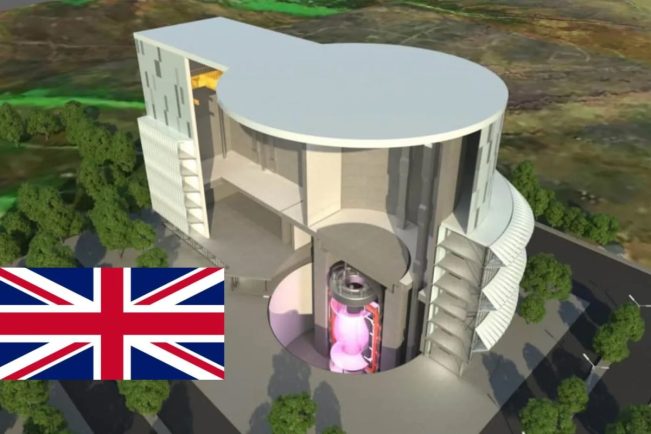
The success at Culham is not just a scientific milestone, it’s a statement of Britain’s enduring leadership in global fusion research. The lessons learned from MAST-U will directly inform the country’s boldest energy project yet: STEP — the Spherical Tokamak for Energy Production, a prototype fusion power station targeted for the 2040s.
Fulvio Militello, Executive Director of Plasma Science and Fusion Operations at UKAEA, hailed the achievement:
“I’M DELIGHTED WITH THE GROUND-BREAKING FINDINGS FROM OUR TEAM AT UKAEA. THESE ACHIEVEMENTS REINFORCE THE UK’S LEADERSHIP IN FUSION RESEARCH AND BRING US CLOSER TO REALISING FUSION AS A CLEAN, SAFE, AND ABUNDANT ENERGY SOURCE FOR THE FUTURE.”
A Cautious but Bright Horizon
The scientists at Culham know there are still hurdles ahead. Fusion is among the most demanding challenges in physics, and no one claims victory yet. But optimism is growing. Each new advance, each controlled plasma, each stable experiment, pushes the dream further into reach.
From Oxfordshire, British innovation is once again reaching for the stars, and this time, it may just succeed in bringing their power home.