What types of brake pads are available, and how to change it in the car?
The braking system is one of the fundamentals of any vehicle’s safety. The main component of this system is the brake pads.
Read about what brake pads are, how they are designed and work in different cars, as well as about the selection, replacement and maintenance of the pads in the proposed article.
A brake pad is a metal plate on which the friction lining is fixed. The size and shape of the plate varies from car to car, although in some cases the pads may fit different brands of cars.
Brake pads consist of two main parts: a metal plate, which acts as a base, and a friction lining. The material of the lining directly affects the braking characteristics. According to this criterion, pads are divided into the following types:
ceramic – composed of ceramic fibers, and in the form of a filler used non-ferrous metals or rubber. They are wear-resistant and durable pads. They have a coefficient of friction, do not lose their properties at high and low temperatures, create less dust. But ceramics do not dissipate heat, which can lead to overheating of the brake pads, and also damage the brake disc faster;
organic – made from organic materials such as carbon, rubber, graphite, kevlar, rubber with the addition of metals, the amount of which does not exceed 15%. Due to such composition of the friction lining the pads are soft and not noisy, they do not squeak and do not wear out the brake discs. At the same time such pads are dusty, short-lived and lose their qualities at high temperatures;
semi-metallic – they are made of ferrous and non-ferrous alloys with the addition of synthetic materials, resins, graphite. Metal content in them is from 50 to 70 %. Such pads are resistant to high temperatures and wear, long service life and good heat dissipation, which reduces the risk of overheating. However, they perform poorly at low temperatures, as well as being noisy and reducing the service life of brake discs or drums;
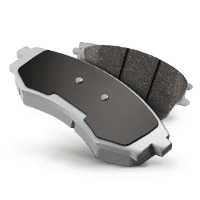
Image about brake pads from autodoc.co.uk
Over time, the brake pads wear out and need to be replaced, usually the pads last 15-30 thousand miles, but here you should be guided by the actual thickness of the friction linings or the wear gauge. Usually, the pads are replaced when the thickness of linings is 2-3 mm. In modern cars pads are replaced as a set, in many trucks (especially domestic) provides for the replacement only friction linings. The pads are replaced in each vehicle according to the owner’s manual.
First, the front brake pads need replacement more often than the rear pads. The reason is that the braking force on many cars is realized in such a way that the front brake pads work constantly and are under more strain. In turn, the rear wheels actively brake only during emergency braking.
Note, the brake pads are only changed in pairs on the same axle. To replace the front brake pads, you must:
Park the car on a level platform, put the wheel chocks under the rear wheels. Next, you should unscrew the cap of the brake fluid reservoir, so that the piston of the operating cylinder moved more easily;
Then you will need to loosen the wheel bolts and raise the front of the car on a jack.
Now you need to turn the steering wheel to have the most convenient access to the caliper and remove the wheel. After removing the wheel, inspect the brake disc (if necessary, it must be replaced along with the pads). If the brake disc is normal, you can unscrew the caliper guides and lift the caliper cover. Now the new brake pads can be installed, and then a clean rag to remove the remaining grease. Lubricate the caliper guides and screw.
Repeat on the second wheel, and then you need to screw the cover of the reservoir with the brake fluid; The final step is to check the performance and tightness of the system (to test the brake pedal must be pressed several times).