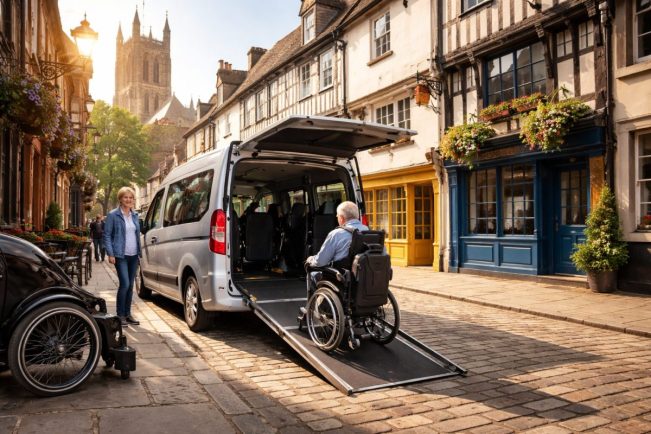
Stairs and steps are part of everyday life in Worcester. For thousands of residents with mobility challenges, they are something else entirely.
A GP surgery visit, a trip to family, a basic run to the shops. All of it becomes a calculation.
Uneven pavements, stepped entrances, multi-storey buildings. What others walk past without thinking, wheelchair users navigate with planning. Independence, in that context, comes down to one thing: transport that actually works.
Adapted cars and vans let people travel safely without leaving their wheelchair. No difficult transfers. No rearranging someone else’s schedule. Confusion still surrounds how these vehicles are converted, what standards govern them, and what the real costs look like. That confusion has consequences. Knowing the options changes decisions. Decisions change lives.
Why Worcester’s Streets Are a Mobility Problem
Worcester’s medieval street layout was built without any concept of a wheelchair. Cobblestones on Friar Street. Sudden level changes throughout the Cathedral Quarter. Historic building entrances with steps that predate any accessibility standard by several centuries.
Council accessibility audits flag a significant portion of Worcester’s city centre as exceeding recommended gradient thresholds. Not marginally. Meaningfully. Pavements shift without warning in areas where drainage and surface repairs have been losing a slow battle against heritage preservation requirements for decades.
Winter sharpens the problem. Ice on sloped cobblestones is not just uncomfortable. It is a measurable hazard. Falls and near-misses concentrate in those same heritage streets every cold season, and data tied to slip risk on uneven paving surfaces shows how surface wear, drainage limits, and material choice combine to increase instability under foot. The surface cannot be easily changed. The risk does not go away.
For many residents, routes are already managed down to the metre. When those routes fail, private adapted transport stops being a preference. It becomes the only workable answer.
How Wheelchair Accessible Vehicles Help
The core problem with standard cars is the transfer. Moving from a wheelchair into a conventional seat requires strength, assistance, and time. For many users it carries genuine injury risk. Wheelchair accessible vehicles remove that step entirely.
A properly converted vehicle lets the user remain in their wheelchair for the whole journey. Modern conversions use lowered floors and integrated ramps certified to EC Whole Vehicle Type Approval and PAS 2012 standards. Two frameworks that govern how modifications are built and what testing a vehicle must pass before it can legally operate on UK roads. Restraint systems are anchored to reinforced floor mounting points designed to meet crash-test specifications for frontal and side impacts.
Both manual and powered wheelchairs are accommodated. Costs vary: a basic conversion differs substantially from a fully adapted vehicle with a powered ramp and climate controls. Allied Mobility specialises in exactly these conversions, and their Allied Mobility range covers new and used wheelchair accessible vehicles for sale built to EC Whole Vehicle Type Approval and PAS 2012 standards. Cash prices start from around £27,995 for smaller models. Motability advance payments from £3,995 for eligible customers.
Rear Entry Versus Side Entry Configurations
Two layouts. Very different problems solved.
Rear entry vehicles deploy a ramp from the back of the vehicle. The wheelchair user boards from behind and travels facing forward. This suits family vehicles well and works for users who transfer to a standard driver’s seat after boarding. Parking requirements are manageable. The ramp extends rearward, which most street spaces accommodate without difficulty.
Side entry vehicles use a ramp deployed through a sliding side door. The wheelchair user boards from the pavement side and remains in their chair for the entire journey. This suits powered wheelchair users, or anyone for whom transferring creates safety risk. The trade-off is real: a wider parking space is needed for the ramp to extend fully. Worth it for the right user. Not always practical in tighter Worcester side streets. It is worth checking your most-used spots before committing to a configuration.
Choosing between them means being honest about where the vehicle will actually be used. Home parking, the GP surgery car park, the supermarket, the workplace. Each location matters. Think through the real journey, not the ideal one.
Motability Scheme Access in Worcestershire
The Motability Scheme removes the upfront cost problem. Worcestershire had a substantial number of active customers as of 2024, reflecting genuine local uptake rather than awareness alone.
Eligibility requires the higher rate mobility component of Personal Independence Payment or Disability Living Allowance. That allowance goes directly toward leasing an adapted vehicle. Insurance, servicing, and breakdown cover are all included. No separate policies to manage. No unexpected bills for standard maintenance. Changes tied to recent Motability Scheme changes to the UK show how eligibility, package structure, and support levels continue to evolve, affecting how applicants access and use the scheme in practice.
New conversions available through the scheme come with full manufacturer warranties. Home demonstrations can be arranged locally. A specialist brings the vehicle directly to the customer’s address. No travel to a distant showroom. No managing an unfamiliar transport route just to assess a transport solution.
Safety Standards and MOT Considerations for Adapted Vehicles
All wheelchair accessible vehicles for sale in the UK must meet either Individual Vehicle Approval or EC Whole Vehicle Type Approval standards. These are not recommendations. They govern how modifications are carried out and what testing is required before a vehicle can legally operate on public roads. Requirements tied to UK vehicle type approval standards requirements define the certification process, ensuring that each adapted vehicle meets strict legal and safety thresholds before entering service.
PAS 2012 covers wheelchair restraint systems specifically. Crash-test requirements. Frontal and side impact simulations. The restraint must hold the wheelchair securely under both conditions. Every year, annual MOT testing includes dedicated checks on ramp mechanisms, floor integrity, and restraint anchor points. Hydraulic and electric ramp systems are examined for function and wear. Floor panels are inspected for corrosion that could weaken the mounting structures beneath the chair.
Documentation for any adapted vehicle should include the converter’s approval number and a full record of modifications. Used wheelchair accessible vehicles retain their certifications provided modifications have not been altered since original approval. A certified used vehicle carries the same legal protections as a new conversion. For buyers working within a tighter budget, that matters considerably.
Buy from a specialist. Verify the paperwork. Ask for the approval number before anything else.
What Worcester Residents Should Do Next
Most people researching adapted transport spend weeks gathering information from scattered sources before taking any action. That delay has a cost. Every week without the right vehicle is another week of managed routes, missed appointments, and dependence on other people’s availability.
The clearest starting point is a home demonstration. A mobility consultant brings the vehicle to the customer’s address, walks through the configuration options in a real environment, and answers questions specific to the household’s situation. No pressure, no showroom, no complicated journey to get there. For Worcestershire residents already receiving a qualifying mobility allowance, the Motability Scheme means a new adapted vehicle may be accessible with no large upfront payment required.
For many Worcester residents, mobility barriers are not abstract. They shape every decision, every route, every day. The right vehicle removes more than a physical obstacle. It restores routine, access, and independence in a way nothing else can. Getting informed early and choosing the right solution changes what daily life looks like going forward.