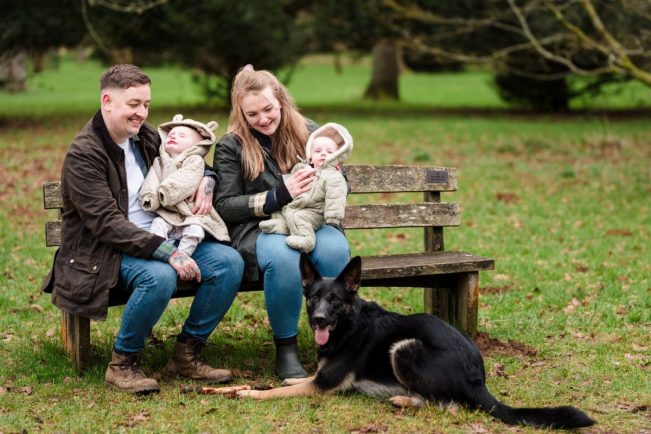
LIKE MOST two-year-olds Freya is her mum’s ‘little bestie’ and loves listening to bedtime stories.
And she certainly lets everyone know when her parents are making her do things she doesn’t love, like bathtime.
But unlike every other toddler Freya has seizures everyday and spends time at pallative play sessions at Acorns Children’s Hospice.
Freya’s mum, Sophie, has told her story as part of the hospice’s Spring Appeal to shine a light on the positive impact the charity has on family life.
When Freya was just three days old, she suddenly stopped breathing at home after suffering a severe bleed on the brain.
The evening that Freya stopped breathing, Sophie had already called Triage ‘three or four times’ for advice. Just one hour after the final call, the newborn suffered a cardiac arrest and turned blue.
“We were in sheer panic,” Sophie said. “We called 999 and the emergency services instructed Jack (Freya’s dad) how to do CPR while we were waiting for the ambulance.”
After a brain scan, doctors discovered she had suffered an intracranial haemorrhage and was referred for brain surgery.
Sophie said: “It was devastating; we didn’t know what had happened. At that point we were still getting messages of congratulations but were also being told that Freya was going to die. There’s no way of comprehending it all really.”
The couple were told Freya had suffered a rare congenital condition called a developmental venous anomaly (DVA), which affects veins within the brain which had led to a blood clot.
Further devastating issues were discovered and Freya was diagnosed with nonketotic hyperglycaemia (NKH) – a life-limiting condition that causes severe neurological symptoms.
More than half of babies born with the condition die within the first week of birth. Few children with severe NKH survive past their fifth birthday.
Sophie, who is a neurosurgery nurse, said: “Being told that your baby is going to have a lifelong disability, and that their time won’t be as long as it should be, it’s very isolating. It’s a really lonely place to be.
“When I went to the baby group at Acorns for the first time you realise you’re not actually alone. There are other parents who are in a similar situation, and it makes it that little bit easier knowing that you’ve got people to talk to, and that they know what you’re going through.
“The first time we came to Acorns it was just lovely. It’s an amazing atmosphere when you walk in; it’s just such a friendly place. Then you see all the staff interacting with the children, they were happy and it was so nice to see.”
Freya benefits from multisensory therapy, palliative play sessions and clinically supported stays at Three Counties, based in Worcester.
Sophie said: “When coming to Acorns, it’s like a big weight lifted off your shoulders, because obviously the nurses can do Freya’s feeds and prepare her medications, and while you still worry, it allows you to worry a little bit less.
“It lets us go to bed at a normal time, and you’re not constantly clock watching and symptom watching. It’s given me the opportunity to see what life is like as just a mum, rather than just as a medical mum. Jack is also a wonderful dad.”
Freya, who now has a baby brother called Rowan, continues to enjoy sensory play, water beds, twinkling lights, music and story times – and while she loves the family dog Margo, she doesn’t like her ‘kisses’.
Sophie said: “Freya loves it at Acorns, she enjoys all the sensory activities, and the nurses take her on little days out and she adores it there.
“It will always be in the back of our minds of what will happen in the future, but Acorns has given us so much invaluable care and means that life is just that little less fraught.”
For more or to donate click here.