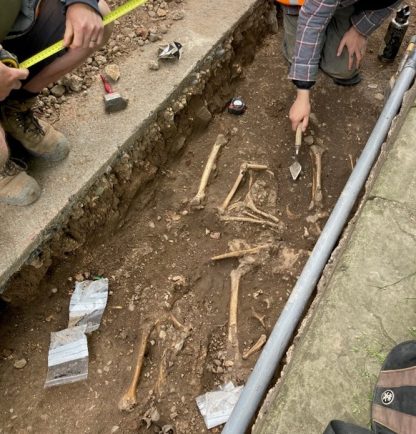
ARCHAEOLOGICAL digs at Worcester Cathedral have unearthed some fascinating clues as to how the site was used in the past.
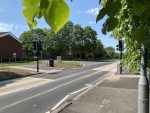
The work by Worcestershire Archaeology has been carried out prior to a landscaping project which will see improvements to College Yard, transforming hard landscaping into an accessible, welcoming green space aimed at bringing the city and cathedral together.
The area on the north side of the cathedral was the city’s burial ground for around 750 years, until the 19th Century. A small number of pre-Victorian skeletons have been excavated and will undergo analysis before being sensitively re-interred in the cathedral’s charnel crypt.
A Roman cobbled surface was also uncovered close to the north porch, providing a rare glimpse of Roman Worcester. Among the cobbles were fragments of several types of quern stone for grinding flour, the neck of a blue glass perfume bottle and a decorative stamp made from a sheep bone.
The cobbles also contained broken pottery which helps date the surface, thought to have been out of use by the 4th Century AD, as it was covered over by mud containing a coin of this date.
Hints of a possible pre-Norman detached bell tower associated with the medieval parish church of St Michael’s were also picked up. The tower was demolished towards the end of the 17th Century after it fell into disrepair following its lead roofing being stripped during the Civil War.
Most of the medieval archaeology discovered relates to the burial ground, but the team also found the buried walls of the sacrists’ lodging in the early 1700s with a wealth of medieval painted glass in the demolition material.
Next to the sacrist’s house, the team found significant quantities of 14th to 16th Century window glass of various forms, blacksmithing waste and a pit of ochre, all within a building footprint which was probably of timber-framed with internal timber stakes that had evidently burnt down.
Further west, between the north porch and the Bishop’s house, the buried walls of the charnel crypt built in 1224 was discovered. A chapel once stood above the crypt, but this was demolished in the 17th Century, and the below-ground crypt re-roofed in 1866. The crypt is still used today.
Worcester Cathedral’s archaeologist, Fiona Keith-Lucas, said: “We found some fantastic things during enabling archaeology work. All artefacts are yet to be analysed, but we are getting a good feel for the site and its complexity. We hope to share our findings in more detail at a symposium in the summer of 2025.”
Work to create the landscaping project which is being undertaken by Fitzgerald Contractors Ltd started on September 16 and is expected to be completed by March 2025.
The long term aim is to create a pedestrianised route all the way around the cathedral, from College Yard, through the west gardens, down to the river, then back through College Green and College Precincts, to the main College Yard entrance.