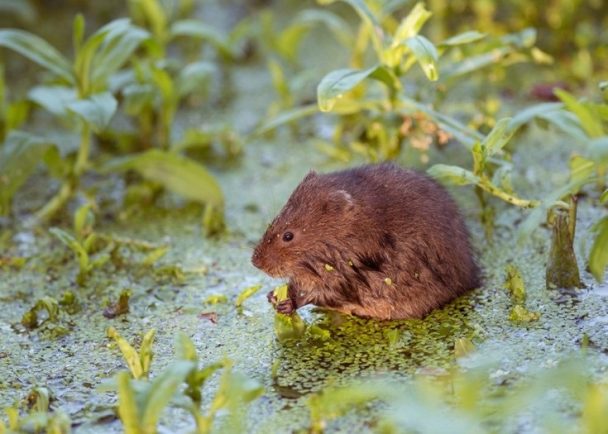
VOLUNTEERS across Britain are being called to help save one of the nations fastest declining animals by taking part in a nationwide water vole survey.
The survey, organised by People’s Trust for Endangered Species (PTES), requires volunteers to visit a local waterway and record their findings online before the deadline on June 15.
PTES’ National Water Vole Monitoring Programme, which was set up in 2015 to try and combat the decline in water vole populations relies on data collected by the survey to help monitor water vole populations and habitats to help focus conservation efforts.
The animals, which have glossy dark brown fur and a blunt snout with small, black eyes, rounded ears and furry tails, underwent one of the most serious declines of any wild mammal in Britain during the 20th century.
Emily Sabin, water vole officer at PTES said: “Arguably the best-known water vole is Ratty from The Wind in the Willows.
“Yet, despite his prominence water voles continue to experience an ongoing decline, are listed as Endangered on the Red List for Britain’s Mammals and are now facing extinction in Britain
“thanks to historical agricultural intensification, habitat loss “and fragmentation, and predation from non-native American mink.
“We’re asking volunteers to find their nearest stream, ditch, river or canal, and look out for water voles, listen for their characteristic ‘plop’ as they dive into the water, or see the signs they “leave behind – from footprints and burrows in the riverbank “to feeding signs and droppings. Any sightings or signs of American mink should also be recorded.
“Last year 216 sites were surveyed, with 85 showing signs of water voles. This builds on 2021’s data, where 116 sites were surveyed with 47 indicating water vole presence.
“We really hope even more people can take part this year to help us further understand how water voles are faring.”
Emily added: “No prior experience is needed, and we’re offering free online training and Zoom talks so that anyone can find out more and hopefully get involved.
“There are over 400 pre-selected sites volunteers can choose from, and if there isn’t a site nearby new sites can be registered.
“We have hundreds of fantastic volunteers who survey water voles for us every year, but given the severe decline water voles have experienced, more help is always needed.”
Water voles were once a common sight along Britain’s inland waterways, but loss and fragmentation of suitable habitat, combined with the arrival of non-native American mink in the 1980s and 1990s, has resulted in their catastrophic decline.
PTES’ National Water Vole Monitoring Programme builds on previous work by the Vincent Wildlife Trust and aims to ensure water voles become commonplace once again.
Visit: www.ptes.org/watervoles for more information.