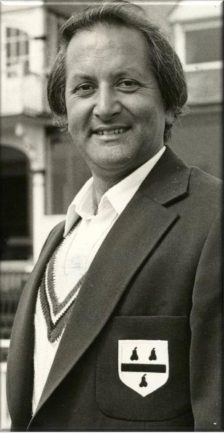
CRICKETING legend and one of Worcester’s most famous adopted sons Basil D’Oliveira will be honoured with the freedom of the city by council chiefs, almost seven years after he passed away.
Councillors gave their unanimous backing for Mayor of Worcester Coun Jabba Riaz’s call to posthumously award the honour to ‘Dolly’ at a meeting last Tuesday.
The gesture will mark half a century from the ‘D’Oliveira Affair’, a watershed moment which began the destruction of apartheid in South Africa and will see D’Oliveira become only the fourth recipient of the highest honour Worcester City Council can bestow in the last decade following Cecil Duckworth in 2008 and former Mayor of Worcester Mike Layland and the Queen’s Royal Hussars in 2014.
Speaking at the meeting, Coun Riaz described D’Oliveira as a ‘cricketing icon’ and described his immense contribution to cricket in Worcestershire after the became the first non white South African to play county cricket when he joined Worcestershire in 1964.
“Worcester hasn’t recognised the role Basil played on the world stage and I’m delighted we can ensure that is no longer the case,” he said.
Conservative councillor Andy Roberts seconded the call and hailed D’Oliveria as ‘our local hero’, words echoed by Coun Stuart Denlegh-Maxwell who paid a personal tribute to the cricketing great.
“I had a coaching session from Basil when I was younger and I can remember Duncan Fearnley giving me a bat which Basil signed,” he said.
“He was a great man and I think it’s a wonderful idea.”
Labour leader Coun Adrian Gregson said: “One of the key aspects of this story is how the family became part of the Worcester community way back in the 1960s right up to the present day.”
Basil D’Oliveira was of Indian-Portugese descent and was born into a Catholic family in South Africa in 1931. A keen cricketer from an early age, he played in South Africa’s national non-white team before emigrating to England in 1960.
His affiliation to New Road began in 1964 and saw him called up for his adopted country in 1966 when he recorded two half-centuries in only his second Test Match against the West Indies at Trent Bridge.
In 1968 the England team was due to play in a tour of South Africa and D’Oliveira was initially not selected because of South Africa’s apartheid rules which prevented black or mixed-race players from competing against white players.
However, there was national outrage in the British press and D’Oliveira was then called up to the England squad. South Africa responded by cancelling the tour.
The affair led to a dramatic turn in international opinion against the South African regime and is credited as being a landmark on the road to the eventual fall of apartheid in the early 1990s.
Basil played for England for a further four years and represented Worcestershire until his retirement in 1979 at the age of 48 where he remained as a coach.
His son Damian played for Worcestershire for 13 years and also followed his father on to the coaching staff before his death in 2014, while the family name lives on today with talented all-rounder Brett D’Oliveira.
A certificate will be presented to Basil D’Oliveira’s family at a civic reception in September and his name will be inscribed on the Honorary Freeman Panel in the Guildhall.
WORCESTER’S MP Robin Walker welcomed the award and recalled the cricketing icon’s ‘quiet and dignified’ stand against apartheid.
During a speech in Parliament following the death of Nelson Mandela in 2013, Mr Walker mentioned the ‘unlikely heroes’ including Basil D’Oliveira in the battle to overcome apartheid.
“His role in showing the cricketing world the unreasonable nature of apartheid and South Africa’s colour bar and in helping to strengthen the sporting embargo against apartheid has been well documented,” Mr Walker said.
“He was no active political campaigner, but in many ways his quiet dignity was a greater challenge to the regime at that time than a more outspoken approach would have been.”
“It is typical of the great Madiba’s (Mandela) generosity of spirit he personally invited D’Oliveira to have lunch with him in 1996 during a coaching trip to South Africa. At the end of their time together he rose from his chair, hugged Basil D’Oliveira and said: “Thanks for coming, Basil…You must go home now. You’ve done your bit.””
Speaking after the decision to grant the freedom of the city was made, Mr Walker said: “I know how much it meant to my father to be granted the freedom of the city and I am sure that Basil D’Oliveira’s family will appreciate this honour being granted in his memory.”