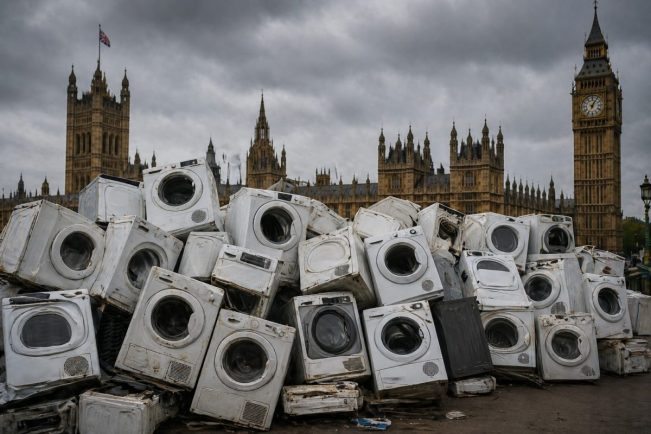
The Government is facing growing criticism over plans to effectively ban the sale of traditional tumble dryers, as part of its drive toward net zero emissions.
Under proposals led by Ed Miliband, conventional condenser, vented and gas-powered dryers would be phased out and replaced with heat-pump alternatives. The move would bring Great Britain into closer alignment with rules already in force in the European Union, and already affecting Northern Ireland under post-Brexit trading arrangements.
Consumers in Northern Ireland are already subject to similar restrictions due to continued alignment with EU product standards. Critics argue that the proposed changes would now extend those rules across the rest of the UK, raising concerns about sovereignty and limiting consumer choice nationwide.
MP Jim Allister, a prominent critic of post-Brexit arrangements, warned:
“Speak up. Stand up for the rights that were delivered to you when Brexit came, and do not allow them to be taken away in this cavalier fashion by this Government.”
Higher costs and longer drying times
Heat-pump dryers, which the Government intends to make the standard, are typically more expensive to purchase. On average, they cost more than traditional machines, with premium models reaching well over £1,000.
They also tend to take longer to dry clothes, sometimes up to 30 minutes more per cycle, raising concerns for larger households that rely on frequent use. Some users report needing multiple cycles to fully dry laundry, potentially offsetting any energy savings in practice.
While ministers argue these machines are cheaper to run over time, critics say the higher upfront cost comes at a time when many households are already under financial pressure.
Performance and safety concerns
Heat-pump dryers operate at lower temperatures and recycle warm air, improving energy efficiency but sometimes affecting performance. Some users report that clothes feel cool or slightly damp at the end of a cycle, particularly in colder conditions.
Safety concerns have also been raised. In 2025, around 85,000 heat-pump dryers were flagged over a potential fire risk linked to a manufacturing fault, prompting warnings from regulators.
Political criticism intensifies
Opposition figures have strongly criticised the proposals. Reform UK’s Richard Tice described the policy as “ludicrous”, arguing it would increase costs and inconvenience families.
Meanwhile, Conservative Shadow Minister Claire Coutinho said the move reflected excessive state intervention, questioning why consumers should not be free to choose which appliances suit their needs.
More broadly, critics argue that the policy is part of an increasingly prescriptive net zero agenda, one that dictates everyday household decisions.
How the changes would be introduced
Rather than an outright ban, the Government says it plans to introduce stricter minimum efficiency standards. Tumble dryers would be rated from A to G, with only higher-rated models allowed to be sold.
All machines would also need:
An eco-setting as a default or easily accessible option
At least 80 per cent condensation efficiency
Strict limits on energy use in standby and off modes
Additional labelling will highlight noise levels, amid concerns that some heat-pump dryers produce a constant low hum.
Government defends policy
The Department for Energy Security and Net Zero insists the changes will reduce energy use and save households money in the long term. A spokesperson said they could save households up to £910 over a 20-year lifespan, arguing this would “put money back into the pockets” of consumers.
However, critics argue that these projected savings are unproven and it will do little to offset the immediate financial burden, reduced convenience, and concerns about reliability.
Part of wider net zero measures
The proposals form part of a wider set of environmental policies, including the planned phase-out of petrol and diesel cars by 2030 and restrictions on gas boilers in new homes.
The new tumble dryer rules are expected to be laid before Parliament in the coming months, setting the stage for a broader political debate over the balance between environmental targets and consumer choice.
LET US KNOW WHAT YOU THINK: Do these changes represent responsible climate action, or an unfair burden on British consumers at a time of rising costs and global disparities in emissions?
Image: For illustration purposes only